


ECOSHADE SHELTERS AND SOLAR TOTEMS SUPPORT PSTA’S ALL-ELECTRIC SPARK SERVICE
LOCATION
t. Petersburg is a thriving Gulf Coast city known for its arts scene, waterfront culture, and fast-growing economy. South St. Petersburg has seen renewed investment as the city works to connect its communities to the broader economic and cultural opportunities of the Pinellas County region. Transit is central to that mission.
The Pinellas Suncoast Transit Authority (PSTA) serves residents across Pinellas County with fixed-route, paratransit, and express services linking neighborhoods to jobs, healthcare, schools, and commercial centers. Its new SPARK service represents a significant step forward: an all-electric bus line designed to deliver faster, cleaner, and more connected transit while bringing South St. Petersburg closer to the region’s economic core.


PROJECT SCOPE
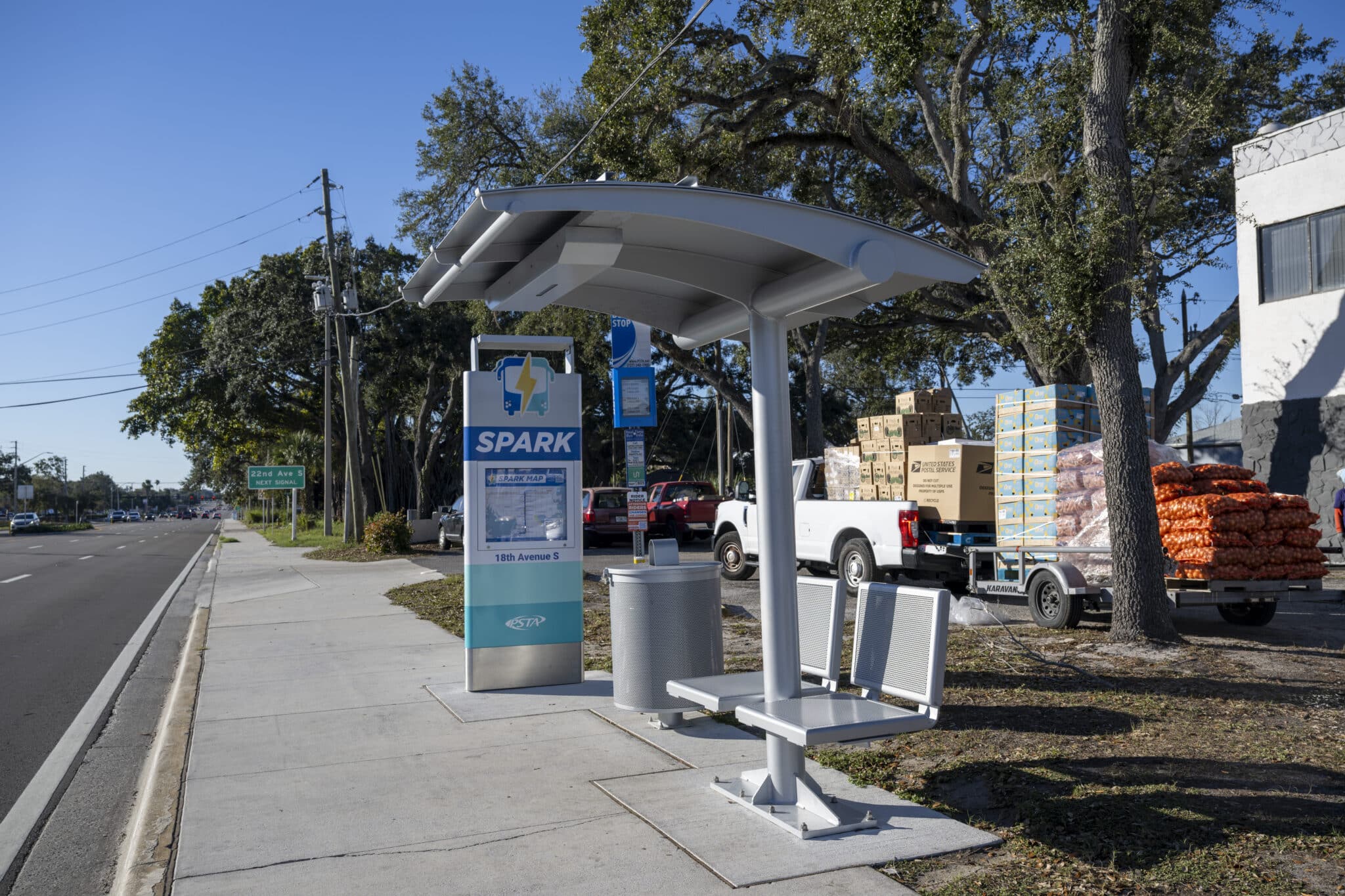
Tolar Manufacturing partnered with PSTA to support the launch of its SPARK service with solar-powered street-level infrastructure designed to match the ambition of an all-electric fleet. Tolar supplied EcoShade Monopole Transit Shelters and 8-foot Solar Lit Totem Signs to outfit SPARK stops with off-grid solar powered lighting, real-time passenger information, and enhanced rider comfort.
The EcoShade Monopole Shelter is purpose-built for stops with limited right-of-way. Each shelter features a protective radius roof with seating for two, plus ADA seating space. An RMS80F solar lighting system powered by 80W roof-mounted panels with integrated battery storage provides dusk-to-dawn security lighting with a minimum of five days of autonomous operation.
Tolar’s 8-foot Solar Lit Totem Signs feature a narrow blade design with a minimal footprint, integrated solar lighting, SPARK Bus branding, and a metal SPARK logo plate. Each totem is accompanied by an EPS13 battery-powered e-paper real-time passenger information sign, delivering up-to-the-second bus arrival data for waiting riders.
The SPARK installation illustrates how solar-powered infrastructure can extend transit service capabilities while reducing dependence on traditional energy sources and supporting agency sustainability goals.
